Step 2 Create Bootable USB from macOS Install Image. Click on Load DMG to import the macOS installation file into the application. Insert a USB (16G free space) and click on the 'Burn' button next to the appropriate media type. The important thing to remember here is that you now know how to create a macOS installer in Windows. For an OS X El Capitan installation, the file gets saved as a disk image named 'InstallMacOSX.dmg'. To install, open the disk image and run the installer named 'InstallMacOSX.pkg'. The El Capitan installer is downloaded to the /Applications folder, with the file name 'Install OS X El Capitan.' If you've installed El Capitan and want to create a bootable installer, re-download the installer from Apple.
In this article we'll run through the steps necessary to create a bootable installer of the Mac operating system, whether it's so you can install the latest version of the macOS on multiple Macs.
In this article, I will show you How to create Bootable USB for Mac OS El Capitan on Windows using Transmac. Therefore, you can create bootable USB for your Mac using Transmac on windows 10/7/8/8.1 here you will learn the easiest method of creating bootable USB. As you know that Mac OS EL Capitan is the newest version among Mac. In here just follow my steps to create a bootable USB installer for your Mac. is the twelfth major of the Mac operating system. Therefore, it has outstanding features that the previous version of Mac doesn’t have that. It is better now that we should create a bootable USB installer drive to install Mac OS.
You all have the information about “Transmac” software about its function that how it works, or how to download “TransMac” and how to install that on your Windows PC? However, you need the following requirements to create a great bootable USB installer for Mac OS El Capitan.
Why we use TransMac to Create bootable USB for mac os el Capitan?
TransMac is a simple application to open hard drives disk, Flash drives, CD/DVD high-density floppy disk on Windows 10/7/8/8.1 or lower version of other Windows. to use this application you just need to insert the drive you need, and one of the great function is this that it will automatically read the drives, TransMac is a great tool that you can access the Mac file on Windows operating system using TransMac.
TransMac Features
- You are allowed to use the TransMac for 15 days trial, and after that, if you want to use that more then 15 days then you need to purchase that. All the features are the same for Mac.
- The system requirements are you need Windows 10/7/8/8.1 or Windows Vista and XP.
- The users can buy TransMac for $59.00 with the license.
- Apple files system (APFS) are only supported.
- Open Mac APFS/HFS/HFS+ format disk drives, flash drives, CD/DVD/Blu-ray media, HD floppies, dmg, dmg part, sparse bundle, and sparseimage files.
- Copy files to Mac and image file
- Format HFS to Mac
- Save and restore image files to disk and USB flash.
- Create, compress image files for Mac
- Burn your ISO file and dmg file directly to CD/DVD Blu-ray.
- View the partition layout
Now Create bootable USB for Mac OS El Capitan on Windows
Now it is the time to create a bootable USB installer using TransMac, To install Mac OS El Capitan on VirtualBox on Windows 10 you need a Bootable USB here you will learn the steps of creating a bootable USB installer for Mac OS El Capitan on Windows.
Step #1. Before going to create a bootable USB for Mac OS El Capitan you need to download TransMac. Therefore, you can download TransMac from the given link. After that, you are download TransMac now install that on your computer, the installation process is too much easy everyone can install that on their PC/Computer with a simple procedure. Just click on the setup file and with some click, the installation will finish. After that, Launch TransMac when TransMac is launched you will see the list of Flash drives or local disk. Then Right-click on that flash you want to create bootable USB for Mac OS El Capitan then select Restore with Disk Image.
Restore with the Disk image
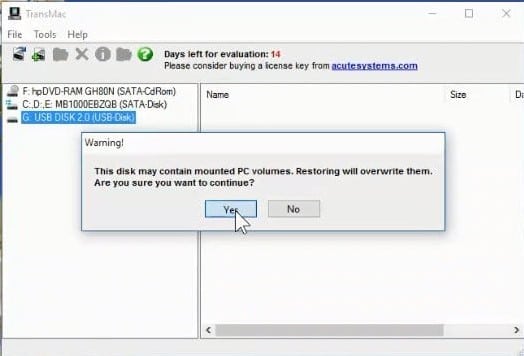
Step #2. Now a warning message will pop-up after you select Restore with Disk Image, and in this step, select Yes.
Step #3. After that, you clicked on yes now a dialogue box will come just click on that and browse for VMDK file and select the file and click Open.
select Mac OS EL Capitan VMDK file
Step #4. After that, you clicked on Open in here your file will be ready to copy on USB drive click on “OK”.
Copying your File VMDK file to USB
Step #5. After that, you clicked OK now in this step, your Mac OS EL Capitan VMDK file will copy to your USB drive. Have patience and wait for some minutes that should copy your file.
Copying Mac OS EL Capitan File to USB
Conclusion
That’s all about it,Now you are totally done with creating the USB drive. Therefore, if you faced any problem regarding this you can comment on below comment box and share your ideas. Furthermore, we will discuss that and don’t forget to subscribe our website with your email address and have a notification about our latest post.
Introduction
A standard install media, (let’s talk about a DVD for easier start) has several files/folders at his root, but most important are:
isolinux(where the loader lives)images(for extra files for installer to load)Packagesfor installation (RedHat/for EL4,Server/Clientfor EL5)
Usually, a distribution has, for its main binaries, more than 2 gigabytes of data, that enables one target to act as a multifunction server/workstation, but that you will not usually load on the same system. Furthermore, since the DVD creation, there have been so many updates/patches that make your installation a ‘outdated’ install that you’ll need to upgrade to have recent patches.
Wouldn’t it be better to have one install media suited for your target systems with all available updates applied?
Preparing everything
First, we’ll need to copy all of our DVD media to a folder in our hard drive, including those hidden files on DVD root (the ones telling installer which CD-sets are included and some other info).
Let’s assume that we’ll work on /home/user/DVD/
After we’ve copied everything from our install media, we’ll start customizing :)
DVD background image at boot prompt
We can customize DVD background image and even keyboard layout by tweaking isolinux/isolinux.cfg with all required fields (Check Syslinux Documentation to check proper syntax)
On Kickstart: instalaciones automatizadas para anaconda (Spanish) you can also check how to create a kickstart, so you can embed it on this DVD and configure isolinux.cfg to automatic provision a system
Including updates
The easiest way would be to install a system with all required package set from original DVD media, and then connect that system to an update server to fetch but not install them.
- EL4:
up2date -du # yum upgrade —downloadonly - EL5:
yum upgrade —downloadonly
After you download every single update, you’ll need to copy them to a folder like /home/user/DVD/updates/.
Well, now let’s start the funny work:
For each package in updates/, you’ll need to remove old version from original folder (remember: Client/Server/ or RedHat/RPMS ), and place in that folder the updated one…
After some minutes, you’ll have all updates in place… and you can remove the DVD/updates/ folder as it will be empty after placing each updated RPM in the folder where the previous versions was.
Removing unused packages
Well, after having everything in place, we’ll start removing unused files. Usually, we could check every package install status on ‘test’ system by checking rpm, but that’s going to be a way lengthy task, so we can ‘automate’ it a bit by doing:
- If you have
sshpassword-less connection between your systems (BUILD and TARGET):
On BUILD system:
- If you don’t have
sshpassword-less setup (using private/public key authentication or Kerberos), you can do something similar this way:
Create Install Media Command Not Found El Capitan
On BUILD system:
Then copy that file on your TARGET system and running:
On TARGET system:
After you finish, you’ll have a file named things-to-do, in which you’ll see commands like rm packagename-version.rpm
If you’re confident about it’s contents, you can run sh things-to-do and have all ‘not installed on TARGET’ packages removed from your DVD folder.

Adding extra software
In the same way we added updates, we can also add new software to be deployed along base system like monitoring utilities, custom software, hardware drivers, etc, just add packages to desired folders before going through next steps.
Recreating metadata
After all our adds and removals, we need to tell installer that we changed packages, and update it’s dependencies, install order, etc.
EL4
This one is trickier, but it is still possible in a not so hard way, first of all, we need to update some metadata files (hdlist) and Package order for installation, it can be difficult if we add extra packages, as we’ll have special care:
Generate first version of hdlists:
Review order.txt to check all packages added by hand to check correct or include missing packages and then continue with next commands:
EL5
Using createrepo we’ll recreate metadata, but we’ve to keep care and use comps.xml to provide ‘group’ information to installer, so we’ll need to run:
Finishing
At this step you’ll have a DVD structure on your hard drive, and just need to get an ISO to burn and test:
Now, it’s time to burn MyCustomISO.iso and give it a try ;-)
Post Datum: While testing is just better to keep using rewritable media until you want to get a ‘release’
Clean Install El Capitan
Like this post? Share on:Twitter❄ Facebook❄ Email